Tell us about the job
Takes about a minute. No obligation.
Electricity heats more occupied homes in Kitsap County, Washington than any other fuel, at 60.1% (2020-2024 ACS 5-year). An electric water heater runs its heating elements and thermostats every day, not just seasonally, so wear builds continuously rather than in bursts. When a contractor opens a unit for diagnosis here, the elements are the first thing they test, because sediment buildup and repeated cycling degrade them before anything else fails. The venting and combustion questions that complicate a gas repair simply do not apply, which narrows the diagnostic path but also means the electrical supply and the thermostat calibration have to be right.
Half the homes in Kitsap County, Washington were built in 1986 or earlier (2020-2024 ACS 5-year). That puts a large share of the county's water heaters well into the age range where sediment has had time to layer at the bottom of the tank and anode rods have given out entirely. When a contractor opens up a failing unit in a house of this vintage, the repair scope often shifts once they see what the tank walls and fittings actually look like. Parts for systems of this age can be harder to source, and whether they are still made is something a contractor confirms before quoting the job.
The Parts of a Water Heater a Contractor Checks During a Repair
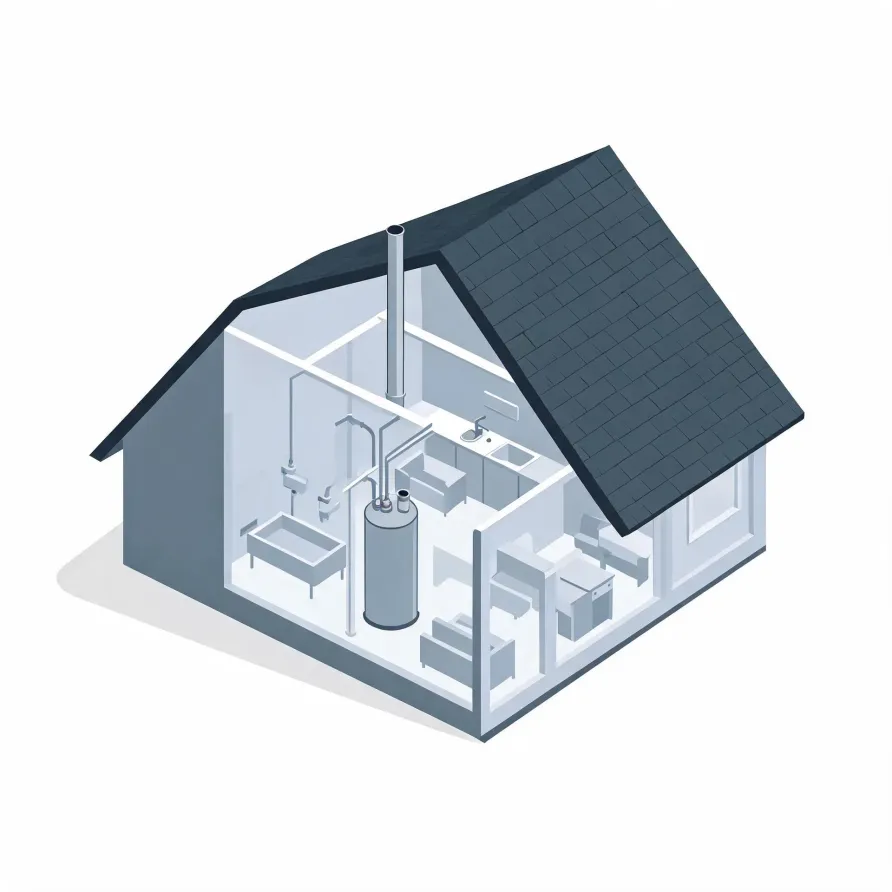
The tank is what most homeowners see first, a large insulated vessel that sits in a utility closet, basement, or garage and holds water at a steady temperature until it is needed. Strapped to or near the tank are the heating elements or burner assembly, the parts that actually raise the water temperature, and these are where a contractor looks when hot water stops arriving or arrives inconsistently.
The pressure relief valve mounts directly on the tank and releases if internal pressure climbs too high, making it a frequent checkpoint during any repair call. The anode rod runs through the tank interior and slows corrosion; the thermostat or gas valve controls the heat level and is another part a contractor tests when the output is wrong.
The drawing shows a typical water heater layout, and a licensed contractor determines which parts apply to the specific unit and setup in your home.
Find a contractor in Kitsap CountyKitsap County, by the record
1 severe weather event was recorded in Kitsap County, Washington between 2015 and 2024.
NOAA National Centers for Environmental Information, Storm Events Database, bulk CSV export, events 2015-01-01 through 2024-12-31.Half the homes in Kitsap County, Washington were built in 1986 or earlier (2020-2024 ACS 5-year).
U.S. Census Bureau, 2020-2024 American Community Survey 5-Year EstimatesKitsap County, Washington holds 116,970 housing units (2020-2024 ACS 5-year).
U.S. Census Bureau, 2020-2024 American Community Survey 5-Year EstimatesOwners occupy 70.1% of the occupied homes in Kitsap County, Washington (2020-2024 ACS 5-year).
U.S. Census Bureau, 2020-2024 American Community Survey 5-Year Estimates