Tell us about the job
Takes about a minute. No obligation.
Electric water heaters run every day, not seasonally, so wear on the elements and thermostats accumulates without pause. Electricity heats more occupied homes in Franklin County, Washington than any other fuel, at 66.6% (2020-2024 ACS 5-year). A contractor diagnosing a failed unit here checks the upper and lower elements before anything else, because those are what a continuous-draw electric system puts through its paces. Sediment buildup on the lower element is a direct result of how hard an electric tank works to maintain temperature across a household that has no backup fuel source to carry the load.
Half the homes in Franklin County, Washington were built in 1997 or earlier (2020-2024 ACS 5-year). A house built around that period came with plumbing chases and electrical service that a water heater contractor rarely has to work around rather than with. What shapes how a repair goes here is what the opened unit contains: the condition of the anode rod, the state of the heat exchanger, whether the parts a unit of that make and model still take are available from supply. The building is not the obstacle. The opened equipment is where the job is decided.
The Parts of a Water Heater a Contractor Checks During a Repair
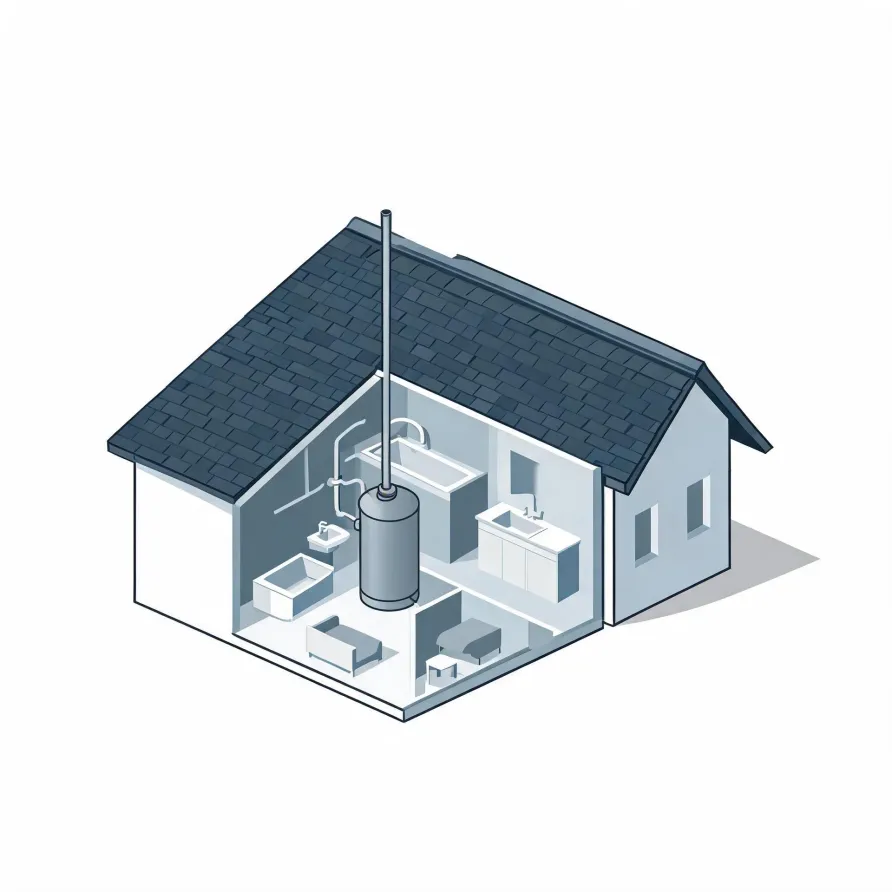
The tank is the piece most homeowners know: a large insulated cylinder, usually in a basement, utility closet, or garage, that holds and heats water until a tap is opened. When repairs are needed, the tank itself and the components mounted to it are where a contractor starts. The dip tube, which carries cold water into the bottom of the tank, and the anode rod, which runs down through the interior and slows corrosion, are both early suspects when water quality or heating drops off.
The thermostat and heating elements sit against or inside the tank and control how hot the water gets. On gas units, a burner assembly and a thermocouple sit at the base, and the flue runs up through the center of the tank to carry exhaust out. The pressure relief valve mounts to the side of the tank and opens if pressure inside builds too high. A contractor checks all of these when diagnosing what has failed.
The drawing shows a typical water heater layout, and a licensed contractor determines which parts apply to the unit in your home.
Find a contractor in Franklin CountyFranklin County, Washington, by the numbers
40 severe weather events were recorded in Franklin County, Washington between 2015 and 2024.
NOAA National Centers for Environmental Information, Storm Events Database, bulk CSV export, events 2015-01-01 through 2024-12-31.Half the homes in Franklin County, Washington were built in 1997 or earlier (2020-2024 ACS 5-year).
U.S. Census Bureau, 2020-2024 American Community Survey 5-Year EstimatesFranklin County, Washington holds 31,183 housing units (2020-2024 ACS 5-year).
U.S. Census Bureau, 2020-2024 American Community Survey 5-Year EstimatesOwners occupy 71.0% of the occupied homes in Franklin County, Washington (2020-2024 ACS 5-year).
U.S. Census Bureau, 2020-2024 American Community Survey 5-Year EstimatesSevere Weather Events in Franklin County
Extreme weather puts real strain on water heaters, forcing them to work harder and wear faster. How often that strain hits Franklin County shapes what repair work looks like here.
40 severe weather events, 2015–2024. Source: NOAA National Centers for Environmental Information, Storm Events Database.