Tell us about the job
Takes about a minute. No obligation.
Electric water heaters run on elements and thermostats, and both wear against the load of a household that has no other fuel to fall back on. Electricity heats more occupied homes in Stevens County, Washington than any other fuel, at 43.2% (2020-2024 ACS 5-year). A contractor diagnosing a failed or underperforming unit here starts with the elements, checks resistance, and looks at whether the thermostat has been holding its setpoint or drifting. Sediment on the lower element is a common finding in homes on well water, and it shortens element life by forcing longer draw cycles to meet demand.
A water heater that needs repair in Stevens County may be running on parts that are getting harder to source. Half the homes in Stevens County, Washington were built in 1985 or earlier (2020-2024 ACS 5-year). Housing built that far back was not fitted with today's equipment on day one; it was updated over the decades, and what a contractor finds once the unit is open reflects that layered history. If a part is discontinued or backordered, the repair timeline and the scope of the job change with it.
The Parts of a Water Heater a Contractor Checks During a Repair
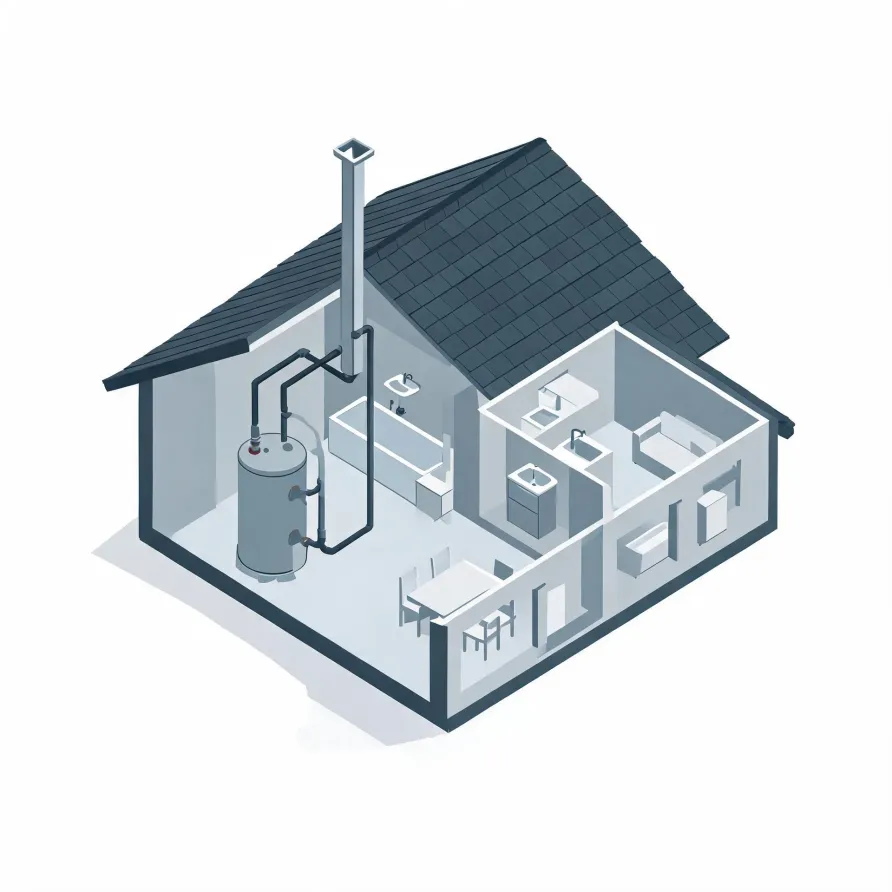
The tank is the piece most homeowners recognize, a large insulated cylinder that sits in a utility room, basement, or garage and holds water at a set temperature. The heating element or burner assembly sits inside or beneath it and is where a contractor looks first when the water runs cold or the unit stops responding.
The thermostat and pressure relief valve sit on or near the tank itself. The thermostat controls when heat is applied, and a fault there can cause water that is too hot, too cold, or inconsistent. The pressure relief valve is a safety component, and a contractor checks it whenever the unit shows signs of leaking or pressure buildup.
The drawing shows a general layout of these components, and a licensed contractor determines what applies to the specific unit and installation in your home.
Find a contractor in Stevens CountyStevens County, Washington, by the numbers
363 severe weather events were recorded in Stevens County, Washington between 2015 and 2024.
NOAA National Centers for Environmental Information, Storm Events Database, bulk CSV export, events 2015-01-01 through 2024-12-31.Half the homes in Stevens County, Washington were built in 1985 or earlier (2020-2024 ACS 5-year).
U.S. Census Bureau, 2020-2024 American Community Survey 5-Year EstimatesStevens County, Washington holds 22,782 housing units (2020-2024 ACS 5-year).
U.S. Census Bureau, 2020-2024 American Community Survey 5-Year EstimatesOwners occupy 79.8% of the occupied homes in Stevens County, Washington (2020-2024 ACS 5-year).
U.S. Census Bureau, 2020-2024 American Community Survey 5-Year EstimatesSevere Weather Events in Stevens County
Extreme weather puts real load on water heaters, forcing them to run harder and recover more often than they would in mild conditions. How much stress that adds depends on what the local climate actually delivers, and Stevens County has its own record.
363 severe weather events, 2015–2024. Source: NOAA National Centers for Environmental Information, Storm Events Database.